

♥ Wishlist
Compare 58 verified Baby Playards for Safe, Flexible Play at Home or Away products in Canada. Reviews, ratings, pros, cons and buying advice updated for October 2026.


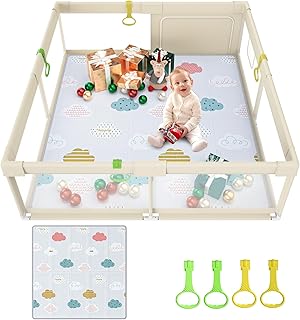


A premium playard can be more than a basic portable sleep-and-play enclosure. For Canadian families, the strongest choices balance safe sleep considerations, structural stability, portability, ease of cleaning, storage, and the quality of the materials and hardware. A higher price should translate into meaningful improvements in everyday use rather than simply a more attractive finish.
When comparing luxury playards, consider the complete ownership experience. A model that looks sophisticated in photographs but is difficult to fold, heavy to move between rooms, awkward to clean, or unsuitable for the space available in your home may be less practical than a simpler alternative.
The term luxury is not a safety classification or a standardized product category. In the Canadian market, it generally refers to products positioned above basic travel playards through a combination of materials, design, engineering, accessories, aesthetics, convenience features, or brand positioning.
The difference between a luxury and standard playard is not necessarily that one is safer than the other. Safety depends on the specific product, its intended use, its condition, correct assembly, and compliance with applicable requirements. Premium pricing should therefore be evaluated separately from safety.
A standard playard may be the better choice for occasional travel, grandparents' homes, or buyers who primarily need a secure contained play space. A premium model can make more sense when the playard is used frequently and its portability, appearance, materials, storage system, or additional functionality justify the higher cost.
The frame is one of the most important components to inspect. A good design should remain stable during normal use and should not rely on excessive flexibility or loose components. Examine how the frame locks into position, whether the locking points are easy to understand, and whether the instructions clearly explain assembly.
Do not assume that a heavier frame is automatically better. Added weight can improve a feeling of solidity, but it can also make a playard difficult to transport. The ideal balance depends on whether the product will remain in one room or travel regularly.
Mesh sides can improve visibility and airflow while allowing a parent to see the child from different angles. Look for securely attached mesh with no obvious loose sections, tears, or damaged stitching.
Visibility is particularly useful when the playard is positioned in a living room, bedroom, or other shared family area. However, ventilation features should never be treated as a substitute for following the manufacturer's intended-use and sleep-safety instructions.
The floor should remain appropriately supported after the playard is fully assembled. Pay attention to the manufacturer's instructions concerning the included base or mattress and whether any additional components are permitted.
A common purchasing mistake is assuming that a thicker or softer aftermarket mattress is automatically an upgrade. For products intended for infant sleep, only use accessories that the manufacturer specifically identifies as compatible and appropriate for the intended use.
A premium playard that is difficult to fold can become frustrating surprisingly quickly. Before buying, investigate the folding sequence, whether multiple steps are required, and how compact the product becomes when stored.
Luxury positioning often places greater emphasis on fabric appearance, but practical considerations should come first. Babies and young children can create frequent spills, stains, and messes, so removable and washable components can be especially valuable.
Check the care label before purchasing. A fabric that requires complicated cleaning may be less practical for daily family use than a simpler material that can be cleaned quickly.
If a playard is designed to be moved, examine the wheels and locking system carefully. Wheels can be useful for repositioning an assembled product, but they should not be interpreted as permission to move a playard while a child is inside unless the manufacturer explicitly allows that use.
Safety should be evaluated independently from luxury branding, aesthetics, customer ratings, or price. Before purchasing a playard in Canada, review the manufacturer's safety information and verify that the specific model is appropriate for the child's age, size, developmental stage, and intended use.
Health Canada provides consumer guidance and product-safety information for children's products. Buyers should also check for current recalls or safety notices affecting the exact model and version they intend to purchase.
Not every product marketed as a playard, travel crib, portable crib, bassinet, or play space has identical specifications or intended uses. Parents should distinguish between a product designed and approved by its manufacturer for infant sleep and one intended primarily for supervised play.
If sleep is an important reason for purchasing the product, read the manufacturer's instructions for the exact model. Do not infer sleep suitability from photographs, retailer descriptions, customer comments, or the fact that another product from the same brand is designed for sleep.
Several established baby-product brands may appear when Canadian shoppers compare premium portable sleep and play products. Brands such as BabyBjörn, 4moms, UPPAbaby, Nuna, Bugaboo, Silver Cross, Maxi-Cosi, Chicco, and Graco cover different approaches to portability, design, accessories, and price positioning.
Brand reputation can be useful as a starting point, but it should not replace model-by-model research. A brand can offer several products with substantially different dimensions, specifications, intended uses, accessories, and age or weight limits.
Customer reviews can reveal practical issues that are difficult to identify from product photography. However, review quality matters more than the headline star rating.
Look for repeated comments concerning setup, folding, durability, cleaning, portability, dimensions, missing components, and long-term usability. Give greater weight to reviews that explain the circumstances of use and identify the exact product configuration.
A sophisticated colour, premium-looking fabric, or minimalist frame can make a product attractive, but these characteristics do not establish that it is the best choice for your household. Start with intended use, safety information, dimensions, portability, and maintenance.
Shoppers often measure the available floor area but forget to measure the storage location. A playard can fit comfortably when open while becoming inconvenient to store in a closet, vehicle, basement, or bedroom.
Extra shelves, changing features, travel bags, organizers, or other accessories can be useful, but only if you will actually use them. Accessories can also increase the number of components that need cleaning, assembly, or storage.
Aftermarket accessories can alter how a product functions and may conflict with the manufacturer's specifications. Always confirm compatibility and intended use before replacing or adding components.
A higher price does not automatically mean a product is safer. Safety should be assessed through the manufacturer's instructions, applicable requirements, product design, proper assembly, and responsible use.
Canadian households can range from compact urban apartments to large suburban homes and rural properties. Winter travel, heated indoor environments, limited storage, and long driving distances can all affect which features matter most. A lightweight and compact model may be preferable for frequent travel, while a more substantial design may be worthwhile for primarily stationary use.
Metal is commonly used where manufacturers need a rigid structural framework. Instead of focusing only on the type of metal advertised, examine the complete frame design, joints, locking points, finish, and overall construction.
Mesh should be securely integrated into the structure and remain intact during normal use. Inspect seams and attachment points periodically, particularly after frequent folding and transportation.
Soft furnishings should be assessed for comfort, cleaning requirements, durability, and manufacturer-approved care methods. Washability can be more valuable than a luxurious appearance when the product is used regularly.
Plastic components can include hinges, connectors, locking mechanisms, wheels, feet, and accessory mounts. Inspect these areas carefully because they can experience repeated mechanical stress during assembly and folding.
For a product marketed as portable, portability should be measured in practical terms rather than simply by the presence of a carrying bag. Consider the complete package: product weight, folded dimensions, bag size, setup time, number of components, and how easily it can be transported from a home to a vehicle.
Measure the location before ordering. The manufacturer's listed dimensions should be treated as essential planning information rather than optional specifications.
Luxury materials can still require regular maintenance. Before purchasing, read the care instructions and determine whether the fabrics and removable components can realistically be maintained within your household routine.
Before use, check the frame, locks, seams, mesh, floor, wheels, fasteners, and accessories. Repeated folding and transportation can place additional stress on mechanical components.
Follow the manufacturer's cleaning instructions. Avoid aggressive cleaning chemicals or techniques that could damage coatings, stitching, mesh, or structural components.
Inspect the playard after transportation and before setting it up for use. Check for bent components, damaged fabric, broken fasteners, missing pieces, or anything that prevents the frame from locking correctly.
Store the product in accordance with the manufacturer's recommendations. A dry, protected storage environment can help reduce unnecessary deterioration of fabrics and components.
The best-value luxury playard is not necessarily the cheapest premium model. It is the product whose useful features justify its total cost relative to how often and how long you expect to use it.
Paying more can be reasonable when the premium provides features that directly solve a recurring problem. For example, frequent travellers may value a substantially easier folding mechanism, while a family using a playard every day may place greater value on durable construction, convenient cleaning, or a design that integrates well into the home.
Conversely, a premium model may not provide meaningful value if the playard will be used only a few times, stored permanently in one location, or outgrown before many of its additional features become useful.
Luxury is not a requirement for a functional playard. A simpler product may be preferable when portability, occasional use, or straightforward operation are the main priorities.
Instead of paying for every available feature, identify the three or four characteristics that matter most for your household. This approach can prevent overspending on features that sound impressive but have little practical benefit.
When reviewing a shortlist of ten products, avoid ranking them solely by price or customer rating. A more useful comparison considers several categories that reflect real-world ownership.
Focus on a lightweight design, compact folded dimensions, a straightforward folding mechanism, and a practical carrying system. Every extra kilogram becomes noticeable when the product is repeatedly moved through airports, hotels, parking lots, or stairways.
Prioritize stability, cleaning, durability, accessibility, and how comfortably the playard fits into your living space. A slightly heavier model can be acceptable when it rarely leaves the home.
Measure carefully. A compact footprint and efficient folded shape can be more valuable than additional accessories. Consider where the product will be stored when it is not being used.
Aesthetic quality can reasonably be part of the purchasing decision, particularly when the product remains visible in a living room or bedroom. However, appearance should remain secondary to safety, intended use, construction, and practical maintenance.
Simplicity usually wins. Choose a product that is easy for the intended caregiver to assemble correctly and whose instructions are clear. A complicated feature set is not an advantage if it creates uncertainty during setup.
Retailer descriptions often emphasize marketing language, whereas technical specifications provide more useful comparison information. When evaluating two luxury playards, place the specifications side by side.
If an important specification is missing from a retailer listing, consult the manufacturer's documentation before making a purchasing decision rather than guessing.
Terms such as “premium,” “luxury,” “next-generation,” “designer,” and “advanced” describe positioning rather than measurable performance by themselves. Translate promotional language into practical questions.
Online shopping makes it easy to compare brands and specifications, but the product page should be checked carefully before purchasing. Confirm the exact model, colour or configuration, included accessories, dimensions, and seller information.
Prices, promotions, inventory, delivery estimates, and retailer policies can change. Compare the current listing with the manufacturer's specifications and review the retailer's terms before completing an order.
There is no single best model for every Canadian family. The right choice depends on whether portability, everyday home use, compact storage, cleaning, design, or another requirement is most important. Compare the exact specifications and intended use of each shortlisted model before deciding.
Not necessarily. Price and safety are separate considerations. A premium price can reflect materials, design, accessories, branding, or convenience features. Safety should be assessed using the manufacturer's instructions, applicable Canadian requirements, proper assembly, product condition, and appropriate use.
Start with intended use, safety information, age and developmental limits, structural stability, dimensions, portability, cleaning, and storage. Once those requirements are satisfied, compare aesthetics, accessories, and other premium features.
It can be worthwhile when premium features solve a genuine everyday problem. Frequent travellers may benefit from easier portability, while families using a playard regularly may value convenient cleaning or durable construction. For occasional use, a simpler model may provide better value.
Only use a playard for sleep when the manufacturer specifically indicates that the exact product and configuration are intended for that purpose. Do not assume that every playard is suitable for unsupervised infant sleep.
Do not automatically add an aftermarket mattress. Follow the manufacturer's instructions regarding the included sleep surface and compatible accessories. An unauthorized or poorly fitting mattress can change the intended characteristics of the product.
Check both the fully assembled dimensions and the folded dimensions. Also measure doorways, storage areas, vehicle cargo space, and the location where the playard will normally be used.
They can be useful when interpreted carefully. Look for repeated, specific observations about setup, folding, cleaning, durability, dimensions, and everyday use. Always distinguish comments about a retailer or delivery experience from evidence about the product itself.
Inspect it before use and periodically during ownership, particularly if it is frequently folded, transported, or moved. Pay particular attention to locks, frame components, mesh, seams, fasteners, wheels, and the floor or base.
Stop using a damaged product until you have determined whether it can be safely repaired according to the manufacturer's instructions. Do not improvise structural repairs or use incompatible replacement components.
The strongest luxury playard purchase is the one that fits your actual routine rather than the one with the longest feature list. Start with safety and intended use, then compare construction, dimensions, portability, cleaning, storage, accessories, and total value.
For Canadian shoppers, it is particularly important to verify the exact model and current specifications because retailer listings, configurations, prices, and availability can change. Read the manufacturer's documentation alongside current retailer information and customer feedback before making the final decision.
A premium playard should earn its higher price through meaningful improvements in usability, construction, portability, or design. If those improvements do not matter to your household, a simpler option may be the more sensible purchase.
This guide is intended as independent consumer information for Canadian shoppers. Product specifications, retailer pricing, availability, configurations, customer feedback, recalls, and manufacturer policies can change during 2026. Before purchasing, verify the current information for the exact product model and configuration you are considering.